
Morning hip stiffness stems directly from nighttime stillness. When you lie in bed for six to eight hours, the synovial fluid within the acetabulofemoral joint cools and thickens, while connective tissue around the pelvis shortens. Aggressive static stretching right out of bed triggers the stretch reflex, causing muscles to guard rather than release. You need a fast, progressive routine that respects early-morning biology while opening the hip flexors, adductors, and rotators before you sit at a desk.
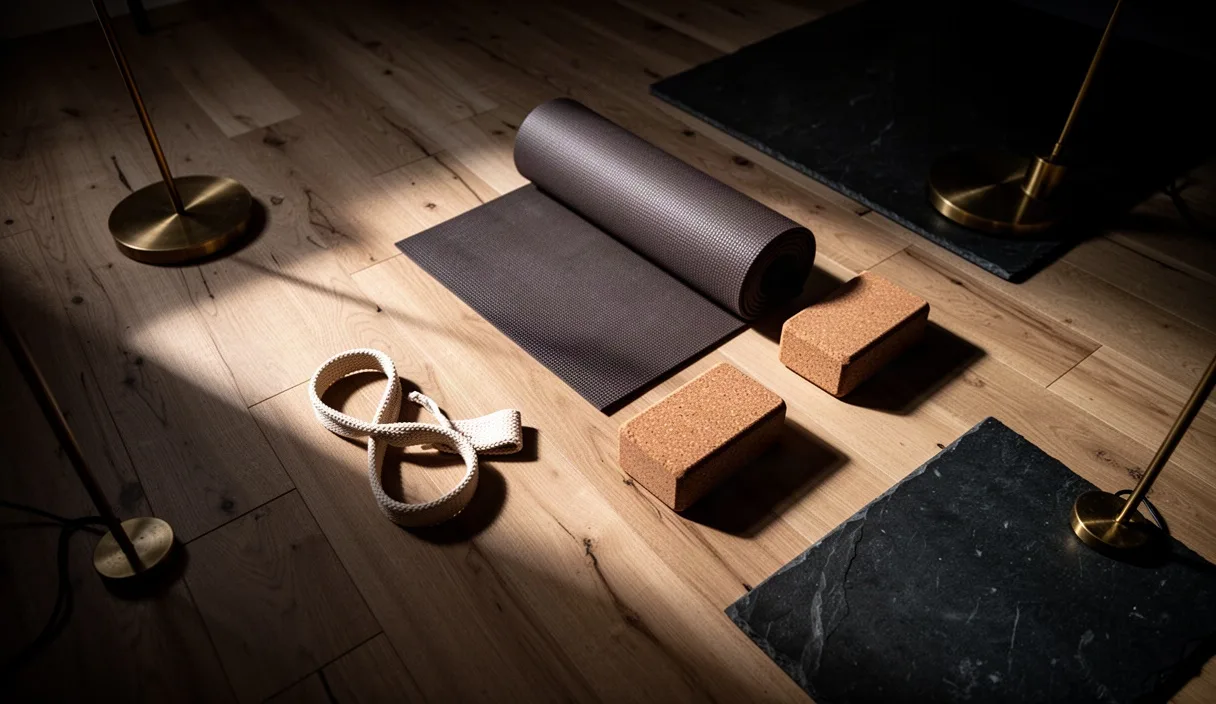
This 15-minute sequence relies on dynamic, low-load movement to restore range of motion. It prioritizes controlled oscillation over passive sinking, using reciprocal inhibition to relax overworked hip flexors through active glute recruitment. Clear a space on your floor, set two dense cork blocks near the top of your mat, and follow the prescribed breath counts to lubricate your joints safely.
Morning joint fluid viscosity and warm-up speed
Synovial fluid is thixotropic. This means its viscosity changes under applied stress and movement. At rest and lower body temperatures, it behaves like chilled honey, offering high resistance to rapid shearing forces. As you begin gentle cyclic movement, friction increases local tissue temperature by one to two degrees, thinning the fluid so it coats the articular cartilage evenly. Attempting deep, end-range postures within the first three minutes of waking forces dry cartilage surfaces to grind against each other, increasing the risk of labral fraying.
Pacing dictates your safety in the early morning. Spend the first three minutes moving between 40 and 60 percent of your maximum joint range. Match your breath to a deliberate cadence: inhale for three seconds, exhale for three seconds. This tempo activates parasympathetic tone while keeping muscular contractions slow enough to prevent defensive spasms in the hip capsule.
Begin on all fours in a tabletop position. Check that your wrists sit directly below your shoulders and your knees rest beneath your hips. Perform slow pelvic tilts rather than full spinal waves:
- Isolate the pelvis by tilting the tailbone toward the ceiling, creating a gentle anterior tilt on an inhale.
- Tuck the tailbone downward into a posterior tilt on an exhale, drawing the pubic bone toward the navel without rounding the upper thoracic spine.
- Repeat this micro-movement for eight slow cycles to introduce motion to the sacroiliac joint.
- Shift your hips in a circular pattern over the knees, making four clockwise rotations and four counterclockwise rotations, keeping the circles no wider than the mat edges.
Low lunge pulses: unloading the iliopsoas
The iliopsoas complex remains shortened during side-sleeping and seated work. Dumping your body weight straight into a deep Anjaneyasana strains the anterior hip capsule and forces the lumbar spine into hyperlordosis. Instead, use controlled micro-pulses to slide the psoas fascia against the femoral nerve sheath without triggering protective tension.
Step your right foot forward between your hands. Lower your left knee to the floor, placing a folded blanket beneath the patella if you experience contact pain. Bring your torso upright and place both hands on your front thigh. Back your hips up until your front knee forms a clean 90-degree angle and your back thigh runs vertical to the floor. Do not collapse forward.
- Posteriorly tilt your pelvis by pulling the front rim of your hip bones upward. You will feel an immediate stretch across the front of the left hip without moving your hips forward.
- Engage the left glute firmly to signal the left psoas to release via reciprocal inhibition.
- Pulse forward by three to four centimeters on the exhale, keeping the pelvic tuck locked in place.
- Return three to four centimeters back to the starting vertical position on the inhale.
- Complete 10 controlled pulses on the left side, pause in neutral, and switch legs to complete 10 pulses on the right side.
Keep your abdominal wall braced at roughly 20 percent effort throughout the pulses. If your lower back arches, you have lost the pelvic tuck and transferred the mechanical load from the hip flexor straight into the L4-L5 vertebrae.
Modified lizard pose using two cork blocks
Lizard pose (Utthan Pristhasana) offers an exceptional release for both the adductor magnus and the deep hip rotators, but placing your forearms on the floor too early forces the pelvis to twist out of square. Cork blocks provide the rigid, stable support necessary to maintain spinal length while you systematically work into the hip capsule.
Place two cork blocks on their medium or high setting parallel to each other inside your front foot. Step your right foot to the outer right edge of the mat, angling the toes out at roughly 30 degrees. Keep your left knee down on the mat, positioned about five inches behind your hip joint to create an open hip angle.
| Block Position | Torso Angle | Primary Target | Recommended Experience |
|---|---|---|---|
| High Setting (vertical) | Roughly 60 degrees from floor | Superficial adductors, anterior capsule | Severe morning stiffness, acute tightness |
| Medium Setting (horizontal) | Roughly 35 degrees from floor | Adductor magnus, psoas insertion point | Moderate mobility, consistent practitioners |
| Low Setting (flat) | Roughly 15 degrees from floor | Deep external rotators, joint capsule | Advanced mobility, warm tissue only |
Lower your forearms onto the cork blocks. Press down through the inner edge of your right heel to prevent the foot from rolling entirely onto its outer edge, which destabilizes the knee. Lengthen your sternum forward toward the front of your mat instead of dropping your chin to your chest. Hold this position for five full breath cycles, maintaining equal weight across both forearms.
Introduce dynamic variation on your next breath: gently rock your right knee outward two inches on the exhale, allowing the sole of the foot to peel slightly off the floor while the ankle remains flexed. Draw the knee back to parallel on the inhale. Execute six of these oscillatory flutters before switching to the left side.
Dynamic warrior transitions for glute activation
Passive stretching creates temporary length, but active muscular control holds the hip joint in balanced alignment for the rest of the day. Moving between standing postures forces the gluteus medius and gluteus maximus to contract under load while the opposing hip flexors stretch dynamically.
From a standing position at the top of your mat, step your left foot back roughly three to four feet. Turn your left toes out to 90 degrees and align the front heel with the arch of the back foot. Bend your right knee until it tracks directly over your right ankle, arriving in Warrior II (Virabhadrasana II). Extend your arms parallel to the floor.
- Inhale, flip the right palm, and reach up and back into Reverse Warrior. Keep the right knee deeply bent at 90 degrees. Avoid dumping weight into the back hand; use your core to suspend the rib cage. Feel the eccentric lengthening along the right side waist and anterior hip.
- Exhale, sweep the right forearm down to rest lightly on the right thigh, and reach the left arm forward over your ear into Extended Side Angle (Utthita Parsvakona). Press down hard through the outer edge of your left heel, firing the left glute to drive the hip forward into alignment.
- Inhale, engage both glutes, and push the floor away to transition back through Warrior II and straight into Reverse Warrior without stopping.
- Execute five fluid transitions between Reverse Warrior and Extended Side Angle, using the full duration of each inhale and exhale to drive the movement.
Straighten the front leg, pivot your feet parallel, and repeat the sequence facing the back of the mat on the left leg. Dynamic standing transitions increase cardiac output slightly, distributing warmed, less viscous fluid through the large lower-limb joints while stabilizing the pelvic girdle.
Supine figure four finish on the floor
Conclude the sequence on your back. Supine postures eliminate gravity-induced spinal compression and allow you to isolate the deep lateral rotators, primarily the piriformis, gemelli, and obturator internus, without loading the lumbar discs.
Lie flat on your back with your knees bent and feet flat on the mat, hip-width apart. Lift your right leg and cross the right ankle over the left knee, creating the shape of the number four. Flex your right foot firmly to a 90-degree angle. This dorsiflexion stabilizes the lateral collateral ligament of the knee, ensuring that all rotational torque occurs within the hip joint rather than the knee capsule.
Thread your right arm through the triangle between your legs and wrap your left arm around the outside of your left thigh. Interlace your fingers behind the hamstring. If your shoulders round off the floor or your cervical spine hyperextends, loop a cotton strap around the back of the thigh instead of straining to reach with your hands.
Keep your sacrum pinned flat against the floor. Many movers pull their knees so close to their chest that their tailbone curls up, turning a hip stretch into lumbar flexion. Maintain the natural curve of your lower back. Hold the posture statically for eight deep breaths, feeling the deep lateral rotators around the right ischial tuberosity lengthen. Uncross gently, place both feet on the floor, wipe your knees side to side twice, and repeat on the opposite side.
Common mistakes
- Collapsing into the lumbar spine: When the hip flexors are tight, the body compensates by arching the lower back. Anchor your pelvis with abdominal tension before extending the hip.
- Forcing knee abduction: Pushing the front knee wide with your hand during lizard pose without flexing the ankle torques the knee joint. Rotate from the femur, not the tibia.
- Rushing breath cycles: Quick, shallow breathing signals a sympathetic stress response, which causes tonic postural muscles like the psoas to tighten defensively. Keep your inhales and exhales at three seconds or longer.
- Lifting the sacrum in supine stretches: Curling the pelvis off the floor negates the stretch across the piriformis. Keep the back of the pelvis heavy on the mat.
Practical next steps
Commit to this 15-minute routine four mornings per week for three consecutive weeks. Set your alarm 20 minutes earlier than usual so you do not rush through the dynamic warrior transitions. Keep your cork blocks situated next to your mat overnight so setup friction remains at zero.
If you experience sharp, pinching sensations in the front crease of the hip during deep flexion, you may be dealing with femoral acetabular impingement rather than simple muscular tightness. Back out of deep lunges immediately. Consult a physical therapist or orthopedist if sharp pain, joint clicking, or numbness down the leg persists during or after these movements.