
Running shortens your posterior chain. Every foot strike generates impact forces between two and three times your body weight, forcing the calves, hamstrings, and glutes to contract eccentrically before snapping back into propulsion. When you stop moving, that repeated shortening leaves your muscles with residual tone and pulls your pelvis into sustained positions that stiffen your lower back.
A focused post-run routine restores functional range without destabilizing the joints you need for tomorrow's miles. You do not need an hour on the mat. You need five targeted postures held with active alignment, calibrated specifically to address post-exercise tissue tone, flush metabolic waste, and re-establish resting length in the hip stabilizers and lower leg compartments.
Tendon stiffness versus muscle tightness after running
Your running stride relies on tendon stiffness. The Achilles tendon and the plantar fascia function like thick mechanical springs, storing elastic energy on impact and releasing it during toe-off. This stiffness is an asset for running economy, reducing the amount of muscular work required to sustain pace. Confusing productive tendon stiffness with contractile muscle tightness leads runners to overstretch dense connective tissues, which can trigger insertional tendinopathy or micro-tearing at bony attachments.
Muscle tightness after running stems from neurological signaling and actin-myosin cross-bridging. Your nervous system maintains elevated motor unit firing to stabilize tired joints, leaving the muscle belly firm and resistant to lengthening. Stretching targets this neurological resting tone in the muscle belly, while aggressive pulling on a tendon simply irritates an already stressed structure. Knowing where the sensation originates determines how you should position your limbs.
| Characteristic | Muscular Tightness | Tendon Stiffness |
|---|---|---|
| Primary Location | Mid-belly of hamstrings, calves, or glutes | Joint junctions, Achilles insertion, behind knee |
| Tissue Quality | Pliable under slow, warm tension | Dense, fibrous, resistant to rapid change |
| Response to Static Stretch | Releases tone within 30 to 45 seconds | Resists lengthening; can inflame if pulled hard |
| Best Intervention | Active lengthening, slow breathing, mild load | Isometric holds, gentle joint mobilization |
| Post-Run State | Hypertonic from repetitive concentric load | Tolerably stiff from repeated elastic loading |
If you feel sharp, focal discomfort right at the sit bones or directly on the calcaneus, you are stressing a tendon junction. Back out of the depth of the posture by 10 to 15 degrees. Shift the sensation into the wide, fleshy mid-section of the muscle tissue, where blood flow is abundant and tissue compliance is naturally higher.
Low downward dog calf pumps with heels grounded
The triceps surae complex absorbs the initial impact of every foot strike. This complex consists of the superficial gastrocnemius, which crosses both the knee and ankle joints, and the deeper soleus, which crosses only the ankle. Standard downward-facing dog often places the hands too far forward for post-run recovery, forcing runners with tight calves to round their lumbar spines or hang suspended on their forefeet without grounding.
Shorten your stance to isolate the lower leg. Set up with your hands roughly 3 feet away from your feet, creating a compact inverted V shape. This shorter lever arm reduces shoulder demand and shifts body mass backward, allowing you to anchor one heel firmly into the floor while bending the opposite knee. Grounding the heel provides the ground reaction force required to signal the muscle spindles in the calf to downregulate tone.
- Place hands shoulder-width apart, fingers spread wide to protect wrist joints.
- Walk feet forward 6 inches closer to your hands than your standard downward dog.
- Press the right heel down into the floor with the right knee straight for 5 deep breaths to target the gastrocnemius.
- Bend the right knee 15 to 20 degrees while keeping the heel rooted to target the deep soleus.
- Switch sides and repeat the sequence for 3 cycles per leg.
Focus on keeping the foot tracking straight forward. Runners often turn their feet outward 15 to 30 degrees in an attempt to get the heel to the mat, which bypasses the medial head of the gastrocnemius and collapses the medial longitudinal arch. Keep the second toe pointed directly toward your wrist, maintaining an active arch even as the heel contacts the rubber surface.
Supine leg extensions: Supta Padangusthasana with strap
Standing hamstring stretches are dangerous for fatigued runners. After miles on the road, your active vitality spinae and hip flexors are tired, leading you to flex the lumbar spine instead of hinging at the acetabulofemoral joint. Supta Padangusthasana removes gravity from your spine by placing your back against the floor, providing a hard feedback surface that prevents pelvic tucking and spinal compensation.
Using a non-elastic webbing strap, loop the center of the band across the ball of your foot, right at the metatarsal heads, rather than under the arch. Placing the strap high on the foot encourages gentle dorsiflexion, which incorporates the distal hamstring fibers and the upper gastrocnemius into the line of tension. Keep the opposite leg active against the floor, pressing the thigh downward to lock the pelvis into neutral alignment.
- Lie flat on your back, head resting comfortably on the floor or a thin folded towel.
- Loop the strap around the right forefoot and extend the right leg toward the ceiling.
- Stop the vertical ascent when your right sit bone begins to lift off the floor; an angle of 70 to 80 degrees is common for runners.
- Push your right heel upward toward the ceiling while simultaneously pulling back on the strap with relaxed shoulders.
- Hold static for 45 seconds, breathing into the lower abdomen at a cadence of 4 seconds in, 6 seconds out.
- Move the leg 2 inches across the midline of your body to target the biceps femoris, holding for another 30 seconds.
Do not force the leg to a 90-degree vertical position. If you pull the leg past your functional range, your pelvis tucks posterior, flattening your lower back against the ground and negating the stretch. Maintain a tiny natural gap between your lumbar spine and the mat, ensuring the stretch stays focused directly in the proximal and middle portions of the hamstring group.
Revolved triangle setup for lateral hip relief
The lateral hip stabilizes your pelvis every time you stand on a single leg during the running gait cycle. The gluteus medius, gluteus minimus, and tensor fasciae latae work continuously to prevent the opposite hip from dropping. When these abductors fatigue, they clamp down, pulling on the iliotibial band tract and creating lateral knee or trochanteric friction.
A modified Revolved Triangle (Parivrtta Trikonasana) using a yoga block targets this lateral hip interface under controlled rotation. Traditional setups place the feet on a tightrope, challenging balance unnecessarily when neuromuscular control is depleted after a run. Set your feet hip-width apart, separated like train tracks, to establish a stable base of support that frees your hip joint to rotate without wobbling.
- Step your left foot back about 3 feet, turning the back heel down at a 45-degree angle.
- Square your pelvis toward the front of your mat by pulling the right hip back and nudging the left hip forward.
- Place a yoga block on its highest setting right along the inside or outside of your right front foot.
- Hinge forward with a flat back, placing your left hand firmly onto the block directly beneath your left shoulder.
- Place your right hand on your sacrum to verify that your pelvis remains flat and parallel to the floor.
- Rotate your rib cage to the right, keeping your right hip pinned back so it does not swing out to the side.
Hold this rotation for 6 complete breath cycles, which translates to roughly 35 to 40 seconds. You should feel intense, clear tension along the outer right hip and down the lateral border of the right thigh. If the sensation shifts to the back of the knee, micro-bend the front leg by 5 degrees to keep the mechanical load centered over the muscular belly of the lateral gluteals.
Seated spinal twist to unlock tight thoracic rotators
Running is a rotational sport. As your right leg swings forward, your left arm drives back, creating continuous reciprocal rotational torque through the thoracic spine. If your thoracic segments lack mobility, your body borrows rotation from the lumbar spine and pelvis, altering stride symmetry and overworking the deep hip rotators like the piriformis and obturator internus.
Ardha Matsyendrasana (Half Lord of the Fishes Pose) unwinds this rotational restriction while simultaneously stretching the deep gluteal musculature. By sitting down, you fix the pelvis and isolate rotation to the mid-back, restoring the rotational separation between your shoulders and your hips that efficient running demands.
- Sit upright on the floor with both legs extended forward; sit on the edge of a folded blanket if your pelvis tilts backward.
- Bend your right knee and step your right foot over your left thigh, placing the sole flat on the floor outside the left knee.
- Keep the left leg extended straight with the toes flexed toward the ceiling, or bend the left knee to bring the left foot near the outer right hip.
- Inhale and reach your left arm upward to lengthen the sides of your waist.
- Exhale and wrap your left arm around your right knee, or place the left elbow outside the right thigh.
- Place your right fingertips on the floor behind your tailbone as a kickstand to keep your spine vertical.
- Turn your chest to the right, initiating the rotation from your navel and ribs rather than wrenching your neck.
Remain in the twist for 8 slow breaths, lingering on each exhalation to find 2 to 3 millimeters of additional thoracic rotation. The pressure of your right thigh against your abdomen also provides gentle visceral compression, assisting in diaphragmatic breathing down-regulation after high cardiovascular exertion. Switch sides smoothly without bouncing.
Common mistakes
Rushing through a post-run routine can produce more inflammation than recovery. Avoid these technical errors to protect your joints and get the most value out of your mat time:
- Stretching immediately without a cool-down: Jumping off the road straight into static postures traps blood in extremities. Walk at an easy pace for 3 to 5 minutes first to bring your heart rate below 100 beats per minute before lying down.
- Bouncing in the stretch: Ballistic movements activate the myotatic stretch reflex, causing the muscle to contract harder to protect itself from tearing. Keep all post-run shapes static and steady.
- Collapsing the lower back: Reaching for your toes by rounding the thoracic and lumbar spine creates disc pressure and bypasses the hamstrings entirely. Hinge from the hip joints and maintain your spine's natural curves.
- Overholding cold tissues: Holds longer than 90 seconds immediately after training can overstretch fatigued ligaments. Limit your post-run holds to between 30 and 60 seconds per position.
- Ignoring the breath: Breathing through the mouth keeps your nervous system in sympathetic drive. Keep your lips closed and use slow nasal inhales and extended exhales to prompt parasympathetic recovery.
Practical next steps
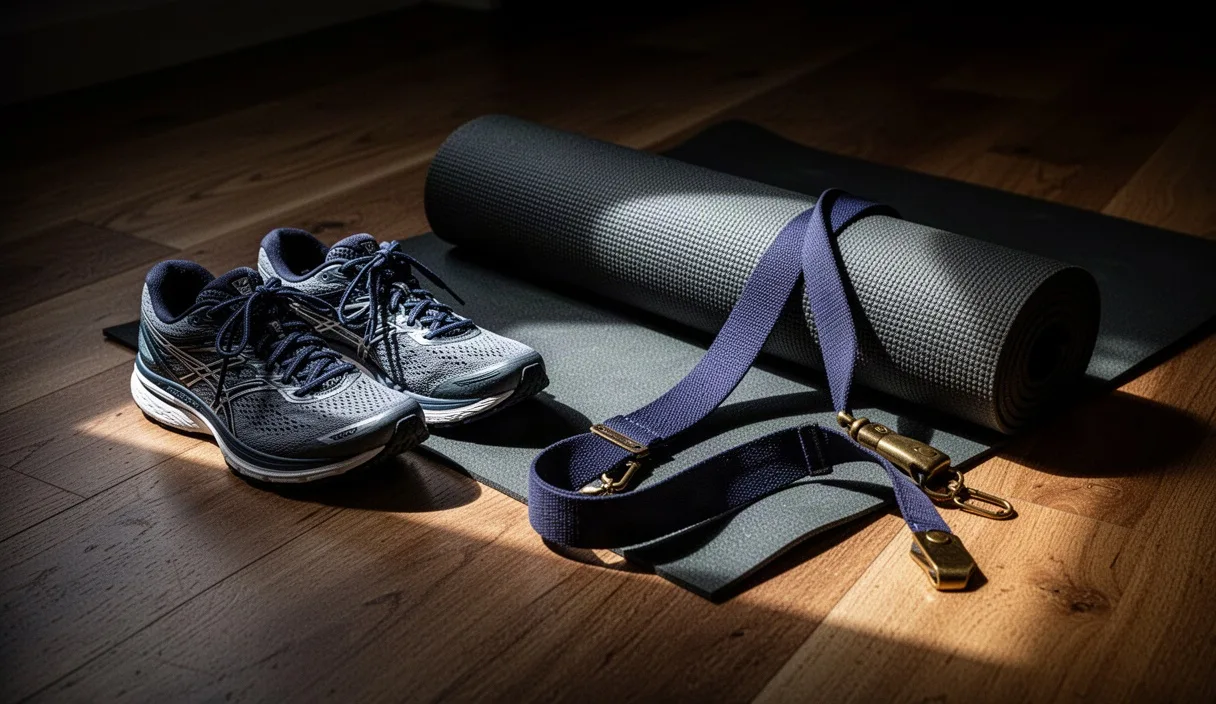
Incorporate this sequence immediately after your cool-down walk while your core temperature remains elevated. Allocate 10 to 12 minutes total, giving yourself time to transition between shapes without rushing. Keep a non-elastic strap and at least one high-density foam block near your shoe storage area so the equipment is within sight when you finish your run.
Track your post-routine mobility across a 3-week block. If you experience persistent, localized pain near tendon attachments, numbness in the feet, or sharp groin pain that does not change with posture adjustments, halt stretching and schedule a consultation with a licensed physical therapist or sports medicine physician. Structural issues and bone stress injuries mimic tightness and will worsen under stretching protocols. Use this routine as an assessment tool: notice which side feels restricted, adjust your stride mechanics accordingly, and protect the tissues that keep you running strong.